Components

Showing posts with label Graphic Cards. Show all posts

Friday, June 1, 2007

MSI GeForce 8500 GT

The main difference between GeForce 8 and GeForce 7 families is the adoption of DirectX 10 on GeForce 8 family. What this means is that they will support the next generation of games to be released starting this year. It also means that instead of using separated shader units for each kind of shader processing (pixel, vertex, physics and geometry) video cards from this family use a unified shader architecture, where the shader engines can process any one of these tasks.

So far AMD has announced their ATI Radeon HD 2000 family – which also supports DirectX 10 and uses unified shader architecture –, however mid-range products will be only available in late June, i.e. one month from now. This leaves mid-range cards from GeForce 8 family like GeForce 8500 GT without real direct competitors.

We can find this model from MSI costing around USD 100, so at this price range we have ATI Radeon X1300 XT competing with GeForce 8500 GT.

GeForce 8500 GT runs at 450 MHz and accesses its 256 MB DDR2 memory at 800 MHz (400 MHz transferring two data per clock cycle) thru a 128-bit interface, so it can access its memory at a maximum transfer rate of 12.8 GB/s.

It has only 16 shader processors running at 900 MHz (GeForce 8600 GT and GTS has 32 shader processors).

  • Graphics chip: GeForce 8500 GT, running at 450 MHz.
  • Memory: 256 MB DDR2 memory (2.5 ns, 128-bit interface) from Hynix (HY5PS561621AFP-25), running at 800 MHz (400 MHz DDR).
  • Bus type: PCI Express x16.
  • Connectors: One DVI, one VGA and one S-Video output supporting component video.
  • Video Capture (VIVO): No.
  • Number of CDs/DVDs that come with this board: Two.
  • Games that come with this board: Toca Race Driver 3 (full).
  • Programs that come with this board: None.
  • Even though this competitor from AMD/ATI does not feature a Shader 4.0 unified engine – i.e. not supporting DirectX 10 – in our benchmark it achieved better results than the reviewed video card. It is important to notice that the Radeon X1300 XT model we compared GeForce 8500 GT to featured GDDR3 memories running at 1 GHz, and there are on the market models with DDR2 memories running at 800 MHz.

    Radeon X1300 XT was between 4.27% and 9.98% faster on 3DMark03 with no image quality settings enabled, but when we enabled anti-aliasing and anisotropic filtering, these two video cards achieved a similar performance at 1600x1200, with GeForce 8500 GT being 5.82% faster than Radeon X1300 XT at 1024x768.

    For the kind of user this video card is targeted – someone willing to spend only around USD 100 on a video card – we think Radeon X1300 XT with GDDR3 memories is a better buy.

    Also, if you have USD 20 more to spend, we highly recommend the Radeon X1650 Pro video card: spending only 20% more you get up to 79% more in performance. That is definitely the kind of deal we are looking for!


    Saturday, May 26, 2007

    ATI Radeon HD 2900 XT

    It has been a long time coming but today AMD is finally set to release its massively anticipated GPU codenamed R600 XT to the world with the official retail name of ATI Radeon HD 2900 XT. It is a hugely important part for AMD right now, who recently posted massive profit loss figures. It is counting on all these new models, along with the high-end 512MB DDR-3 DX10 part with 512-bit memory interface to kick ass and help raise revenue reports against the current range from the green GeForce team, which is selling like super hot cakes.

    Today AMD is launching an enthusiast part HD 2900 series with the HD 2900 XT, performance parts with the HD 2600 series including HD 2600 XT and HD 2600 PRO, along with value parts including HD 2400 XT and 2400 PRO. The HD 2600 and 2400 series have had issues of their own and you will need to wait a little longer before being able to buy these various models on shop shelves (July 1st). The HD 2900 XT will be available at most of your favorite online resellers as of today. Quantity is "not too bad" but a little on the short side with most of AMD's partners only getting between 400 – 600 units which is not that much considering the huge number of ATI fans out there. You may want to get in quick and place your order, if you are interested – some AIB companies are not sure when they will get in their next order, too.

    Our focus today is solely on the HD 2900 XT 512MB GDDR-3 graphics card – it is the first GPU with a fast 512-bit memory interface but what does this mean for performance? While it is AMD's top model right now, it is actually priced aggressively at around the US$350 - US$399 mark in United States, which puts it price wise up against Nvidia's GeForce 8800 GTS 640MB. After taking a look at the GPU and the card from PowerColor as well as some new Ruby DX10 screenshots, we will move onto the benchmarks and compare the red hot flaming Radeon monster against Nvidia's GeForce 8800 GTX along with the former ATI GPU king, the Radeon X1950 XTX.

    Due to limited availability as well as the fact press in different regions are getting priority over others, we tested an actual retail graphics card from PowerColor. It has the same clock speeds as all other reference cards floating around – 742MHz core clock and 512MB of GDDR-3 memory clocked at 828MHz or 1656MHz DDR.

    The PowerColor PCI Express x16 card looks just the same as reference cards. Later on you will see more expensive water cooled HD 2900 XT models from the usual suspects along with overclocked models in the following weeks. We did not get time to perform any overclocking tests but reports are floating around that the core is good to at least 800 - 850MHz and the GDDR-3 memory more than likely has room to increase. You may even see some companies produce HD 2900 XT OC models which use 1GB of faster GDDR-4 memory operating at over 2000MHz DDR or they will use special cooling to get the most out of the default setup.

    As far as size goes, the HD 2900 XT is a little longer than the Radeon X1950 XTX but a good deal shorter than the GeForce 8800 GTX, as you can see from the shot above with the PowerColor HD 2900 XT sitting in the middle of the group. Both of the other cards take up two slots and the HD 2900 XT is no different.

    In 2D mode (non-gaming in Windows), the clock speeds are automatically throttled back to 506MHz on the core and 1026MHz DDR on the memory. This is done to reduce power consumption and also to reduce temperatures, which seems to pretty important for the HD 2900 XT.

    We expect factory overclocked HD 2900 XT cards to start selling in less than one month from now. AIB partners currently have the option of ordering 1GB GDDR-4 models with faster clock speeds but it is unsure if this product will be called HD 2900 XT 1GB GDDR-4 or HD 2900 XTX – you may end up seeing these types of cards appear in early June (around Computex Taipei show time). If we saw a product like this with slightly faster core clock and obviously much faster memory clock (2000 - 2100MHz DDR vs. 1656MHz DDR), we think it would compete very nicely against the GeForce 8800 GTX as far as price vs. performance goes. Sadly we did not have a GeForce 8800 GTS 640MB handy for testing but matching up with our previous testing on similar test beds, the HD 2900 XT will beat it quite considerably, by around the 20% mark in 3DMark06, for example. This is rather interesting since the HD 2900 XT is in the same price range as the GeForce 8800 GTS 640MB – we will test against this card shortly!

    Summing it up, we are happy to see a new high-end Radeon graphics card from AMD – it literally is the red hot flaming monster but it manages to offer a good amount of performance and impressive feature set with full DX10 and Shader Model 4.0, Crossfire and Windows Vista support and a host of others which we did not even have enough time to cover in full today, such as improved anti-aliasing and UVD. It was a long time coming but it is able to offer very good bang for buck against the equivalent from Nvidia - GeForce 8800 GTS.

    It is also something for the green team to think about if AMD comes out with a faster version of R600 XT either with faster operating GDDR-4 memory (and more of it) or faster clock speeds using 65nm processor technology, later in the year. Interesting times ahead in the GPU business but for right now the Radeon HD 2900 XT offers very solid performance for the price but we will be more interested in what is coming in the following weeks as overclocked versions emerge and shake things up even more.


    Nvidia GeForce 8800 Ultra

    WHAT HAPPENS WHEN YOU take the fastest video card on the planet and turn up its clock speeds a bit? You have a new fastest video card on the planet, of course, which is a little bit faster than the old fastest video card on the planet. That's what Nvidia has done with its former king-of-the-hill product, the GeForce 8800 GTX, in order to create the new hotness it's announcing today, the GeForce 8800 Ultra.

    There's more to it than that, of course. These are highly sophisticated graphics products we're talking about here. There's a new cooler involved. Oh, and a new silicon revision, for you propellerheads who must know these things. And most formidable of all may be the new price tag. But I'm getting ahead of myself.

    Perhaps the most salient point is that Nvidia has found a way to squeeze even more performance out of its G80 GPU, and in keeping with a time-honored tradition, the company has introduced a new top-end graphics card just as its rival, the former ATI now owned by AMD, prepares to launch its own DirectX 10-capable GPU lineup. Wonder what the new Radeon will have to contend with when it arrives? Let's have a look.

    By and large, the GeForce 8800 Ultra is the same basic product as the GeForce 8800 GTX that's ruled the top end of the video card market since last November. It has the same 128 stream processors, the same 384-bit path to 768MB of GDDR3 memory, and rides on the same 10.5" board as the GTX. There are still two dual-link DVI ports, two SLI connectors up top, and two six-pin PCIe auxiliary power connectors onboard. The feature set is essentially identical, and no, none of the new HD video processing mojo introduced with the GeForce 8600 series has made its way into the Ultra.

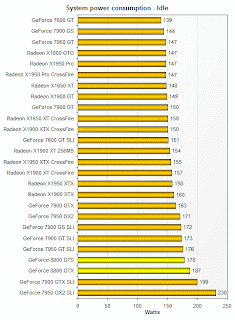
    Yet the Ultra is distinct for several reasons. First and foremost, Nvidia says the Ultra packs a new revision of G80 silicon that allows for higher clock speeds in a similar form factor and power envelope. In fact, Nvidia says the 8800 Ultra has slightly lower peak power consumption than the GTX, despite having a core clock of 612MHz, a stream processor clock of 1.5GHz, and a memory clock of 1080MHz (effectively 2160MHz since it uses GDDR3 memory). That's up from a 575MHz core, 1.35GHz SPs, and 900MHz memory in the 8800 GTX.

    The Ultra's tweaked clock speeds do deliver considerably more computing power than the GTX, at least in theory. Memory bandwidth is up from 86.4GB/s to a stunning 103.7GB/s. Peak shader power, if you just count programmable shader ops, is up from 518.4 to 576 GLOPS—or from 345.6 to 384 GFLOPS, if you don't count the MUL instruction that the G80's SPs can co-issue in certain circumstances. The trouble is that "overclocked in the box" versions of the 8800 GTX are available now with very similar specifications. Take the king of all X's, the XFX GeForce 8800 GTX XXX Edition. This card has a 630MHz core clock, 1.46GHz shader clock, and 1GHz memory.

    So the Ultra is—and this is very technical—what we in the business like to call a lousy value. Flagship products like these rarely offer stellar value propositions, but those revved-up GTX cards are just too close for comfort.
    The saving grace for this product, if there is one, may come in the form of hot-clocked variants of the Ultra itself. Nvidia says the Ultra simply establishes a new product baseline, from which board vendors may improvise upward. In fact, XFX told us that they have plans for three versions of the 8800 Ultra, two of which will run at higher clock speeds. Unfortunately, we haven't yet been able to get likely clock speeds or prices from any of the board vendors we asked, so we don't yet know what sort of increases they'll be offering. We'll have to watch and see what they deliver.

    We do have a little bit of time yet on that front, by the way, because 8800 Ultra cards aren't expected to hit online store shelves until May 15 or so. I expect some board vendors haven't yet determined what clock speeds they will offer.

    In order to size up the Ultra, we've compared it against a trio of graphics solutions in roughly the same price neighborhood. There's the GeForce 8800 GTX, of course, and we've included one at stock clock speeds. For about the same price as an Ultra, you could also buy a pair of GeForce 8800 GTS 640MB graphics cards and run them in SLI, so we've included them. Finally, we have a Radeon X1950 XTX CrossFire pair, which is presently AMD's fastest graphics solution.

    I also prefer the Ultra to the option of running two GeForce 8800 GTS cards in SLI, for a variety of reasons. The 8800 GTS SLI config we tested was faster than the Ultra in some cases, but it was slower in others. Two cards take up more space, draw more power, and generate more heat, but that's not the worst of it. SLI's ability to work with the game of the moment has always been contingent on driver updates and user profiles, which is in itself a disadvantage, but SLI support has taken a serious hit in the transition to Windows Vista. We found that SLI didn't scale well in either Half-Life 2: Episode One or Supreme Commander, and these aren't minor game titles. I was also surprised to have to reboot in order to switch into SLI mode, since Nvidia fixed that issue in its Windows XP drivers long ago. Obviously, Nvidia has higher priorities right now on the Vista driver front, but that's just the problem. SLI likely won't get proper attention until Nvidia addresses its other deficits compared to AMD's Catalyst drivers for Vista, including an incomplete control panel UI, weak overclocking tools, and some general functionality issues like the Oblivion AA problem we encountered.

    That fact tarnishes the performance crown this card wears, in my view. I expect the Ultra to make more sense as a flagship product once we see—if we see—"overclocked in the box" versions offering some nice clock speed boosts above the stock specs. GeForce 8800 Ultra cards may never be killer values, but at least then they might justifiably command their price premiums.

    We'll be keeping an eye on this issue and hope to test some faster-clocked Ultras soon.

    MSI NX 8800 GTS - T2D320E-HD

    Not wanting to leave any enthusiasts out, those looking for the power of the GeForce 8800 family of cards on a budget have had their prayers answered in the form of the GeForce 8800 GTS 320MB card. With prices below $300, the power of the best NVIDIA has to offer is now available for everyone. With the only difference between the two GTS models being the amount of GDDR3 RAM (640MB vs. 320MB) the sub-$300 price is attractive and reasonable.

    MSI took the reference design and upped the ante by increasing the core and memory clock speeds in their NX8800GTS-T2D320E-HD OC offering. The increase in raw speed on the card served as a good reminder that the marketing hype of "more memory = faster" is definitely not always the case as was discovered when put the through the paces against its bigger, but slower, 640MB brother.

    As the chart below shows, the NX8800GTS-T2D320E-HD OC is identical to the 640MB version except in the amount of RAM and the core and memory speeds. Both feature nice boosts in speed that lend to impressively increased performance throughout a number of benchmarks and tests.
    Apart from a few ultra-high resolution instances, MSI's NX8800GTS-T2D320E-HD OC proved that, with a little extra oomph from end-user overclocking, raw speed still can and does have a major impact on gaming performance; while more memory certainly can't hurt, it isn't the be-all cure to ensure faster performance.

    If considering a GeForce 8800 GTS, don't let the lesser amount of RAM fool you: these factory overclocked 320MB GTS cards are packing all the same heat and can perform almost as good and sometimes even better than their bigger-but-slower brother.

    Nvidia GeForce 8800 GTX

    DirectX 10 is sitting just around the corner, hand in hand with Microsoft Vista. It requires a new unified architecture in the GPU department that neither hardware vendor has implemented yet and is not compatible with DX9 hardware. The NVIDIA G80 architecture, now known as the GeForce 8800 GTX and 8800 GTS, has been the known DX10 candidate for some time, but much of the rumors and information about the chip were just plain wrong, as we can now officially tell you today.

    Well, we've talked about what a unified architecture is and how Microsoft is using it in DX10 with all the new featurs and options available to game designers. But just what does NVIDIA's unified G80 architecture look like??

    All hail G80!! Well, um, okay. That's a lot of pretty colors and boxes and lines and what not, but what does it all mean, and what has changed from the past? First, compared to the architecture of the G71 (GeForce 7900), you'll notice that there is one less "layer" of units to see and understand. Since we are moving from a dual-pipe architecture to a unified one, this makes sense. Those eight blocks of processing units there with the green and blue squares represent the unified architecture and work on pixel, vertex and geometry shading.

    The new flagship is the 8800 GTX card, coming in at an expected MSRP with a hard launch; you should be able to find these cards for sale today. The clock speed on the card is 575 MHz, but remember that the 128 stream processors run at 1.35 GHz, and they are labeled as the "shader" clock rate here. The GDDR3 memory is clocked at 900 MHz, and you'll be getting 768MB of it, thanks to the memory configuration issue we talked about before. There are dual dual-link DVI ports and an HDTV output as well.


    NVIDIA should be commended once again for being able to pull off a successful hard launch of a product that has been eagerly awaited for months now. Only time will tell us if supply is able to keep up with demand, but I'll be checking in during the week to find out!

    ATI Radeon X1950 Pro 256MB

    The mainstream video card market is actually comprised of two different levels, separated by the old price-performance matrix. Cards like the GeForce 7600 and Radeon X1650-based products represent the entry-level section, while the top-end offers video cards with greater performance and a higher price tag. NVIDIA has been a serious powerhouse at the upper range, first with the GeForce 7600 GT 256MB, and when that faded, the GeForce 7900 GS 256MB was quick to take its place. ATI has had a very tough time competing, especially as there was initially a huge gap between the Radeon X1600 XT and Radeon X1900 XT cards. This was bridged with the Radeon X1900 GT, but the subsequent Radeon X1900 Pro is the real deal, and better able to stem the NVIDIA tide.

    The Radeon X1950 Pro is built on the 80nm RV570 graphics core, and sports a similar architecture to the lower-clocked, 90nm Radeon X1900 GT. The RV570 features 12 pixel pipelines, 12 texture units, 8 vertex shaders, and 12 ROPs. This may seem low for a high-end mainstream video card, but the Radeon X1950 Pro includes 3 pixel shaders per pipeline, for a total of 36. This can yield a serious performance edge, especially in SM3.0 games. The Radeon X1950 Pro features 256MB of onboard GDDR3 memory using a 256MB link to the internal ring bus controller. This is the latest generation of 80nm ATI parts, and like the Radeon X1650 XT, the Radeon X1950 Pro supports HDCP and "native" CrossFire using internal connectors.
    The base architecture may be similar, but the Radeon X1950 Pro is clocked higher than current Radeon X1900 GT boards, and the RV570 core runs at 575 MHz, while the 256MB of GDDR3 memory is set at 1.38 GHz. This provides theoretical fill rates of 6.9 GPixels/s, 6.9 GTexels/s (standard) and 20.7 GTexels/s (shaded). This last figure helps illustrate just how powerful this type of design can be, given a game or application that really stresses its pixel shading abilities. The memory bandwidth is definitely high-end, as the 1.38 GHz memory clock and its 256-bit link translate into 44.2 GB/s of memory bandwidth - about on par with a GeForce 7950 GT. The Radeon X1950 Pro also includes support for AVIVO, up to 6X AA & 16X AF modes, 3Dc+ texture compression, and native support for CrossFire multi-GPU technology.

    The ATI version of the Radeon X1950 Pro is a standard design without any of the enhancements offered by their 3rd-party vendors. This is both a positive and a negative, as you know the card design is fully tested, compatible and rock solid, but you forgo any higher default clock speeds or nifty cooling apparatus. The card itself is a full-length PCI Express model, with a sleek red heatsink-fan covering virtually the entire PCB. We like this format, especially compared to Radeon X1950 Pro cooling designs with a taller heatsink-fan, as the ATI card offers a seamless install for adjacent peripherals.
    The ATI Radeon X1950 Pro 256MB card is clocked at standard speeds, with its core set at 575 MHz, and the onboar memory running at 1.38 GHz. The card offers the standard connectivity options, featuring two dual-link DVI connectors and an S-Video/HDTV-out port. The DVI output offers resolutions up to 2560x1600, VGA maxes out at 2048x1536, and HDTV-out runs up to 1080i. As with all Radeon X1950 Pro cards, the ATI version also requires external power through a single PCI Express connector. CrossFire is supported in native mode, and t

    The ATI Radeon X1950 Pro retail box includes a CrossFire bridge interconnect for future upgrades. Also included in the bundle are a Driver CD, composite and S-video cables, HDTV-out cable, and DVI to VGA adapters. ATI also offers a 1-year limited warranty and supports operating systems from Windows XP to MCE to Vista.

    MSI NX 8600 GTS T2D256E

    You can tell plenty from the model code of this new MSI graphics card. The 'NX8600GTS' part tells you that it uses the new Nvidia GeForce 8600GTS graphics chip along with 256MB of fast GDDR-3 graphics memory, while the 'OC' suffix flags up the fact that this is a factory overclocked graphics card.

    Nvidia launched the DirectX 10 GeForce 8800 GT and GTX way back in October 2006 so this mid-range chip has been a long time coming. It's given Nvidia time to move from a 90nm fabrication process to 80nm, so the GeForce 8600 uses faster clock speeds on the core, unified shaders and memory than we ever saw on the 8800. This gives us a taste of what we can expect when Nvidia launches the GeForce 8800 Ultra in a few weeks' time to nicely mess up the launch of the ATi Radeon HD 2900.

    Getting back to the MSI, the GeForce 8600GTS chip uses 289 million transistors, compared to the GeForce 8800 which has 691 million. The graphics core runs at 700MHz, the 32 unified shaders are clocked at 1.45GHz and the 256MB of memory has a speed of 2.1GHz, yet the power rating is fairly low at 71W so there's a single six-pin PCI Express power connector.

    MSI calls this an overclocked card but the increase is fairly small as the reference core speeds for an 8600GTS are 675MHz for the core with 2GHz memory speed.

    MSI has clearly given a fair amount of thought to the cooling on this model as the pictures we've seen of competing GeForce 8600GTS cards use a slim-line cooler that looks very similar to a GeForce 7800GTX. MSI has instead opted for a double-slot design that connects the heatsink to a finned radiator. The fan blows cooling air through a duct and across the cooler but there's a sizeable gap between the heat exchanger and the vented bracket.

    We suspect this design is intended to quieten the cooler, however it still seemed rather noisy to our ears and made a continuous drone that was rather off-putting.

    The graphics card is bulky and noisy and the MSI package is rather basic. There's a PCI-E power adapter, two DVI adapters, a splitter cable with Component and S-Video outputs and an S-Video extension cable. Apart from some MSI utilities there is no software in the games department where you would hope for, say, a voucher for Unreal Tournament 2007.

    During our testing we compared the MSI with a GeForce 7950GT, as that is the DirectX 9.0c part that will inevitably be replaced by the GeForce 8600GT, so when we ran 3DMark06 and a few games on both cards in Windows XP and Windows Vista, we were surprised to find that the difference in performance was minimal.

    Sure, there were swings and roundabouts, but you couldn't say that either graphics card was better than the other, and for that matter both of the two operating systems delivered the goods. While the MSI is undoubtedly a very competent performer it came as a real surprise that it wasn't markedly better than the card that it is due to replace.

    The reason is, of course, DirectX 10.

    The GeForce 8000 family all support DirectX 10 and use a new design that replaces dedicated Pixel Shaders, Vertex Shaders and Geometry Shaders with more flexible Unified Shaders. That's a good move which will doubtless reap benefits once DirectX 10 games come to market, but that's still some months in the future.